GUDERIAN GLASS
GUDERIAN GLASS
This website is dedicated to a process of suspending glass within a matrix of super absorbent polymer and distilled water released and open to the public under CC BY 4.0 on May 29th 2026 by Adam Guderian. A full description of the process follows:

Super Absorbent Polymer is a non toxic limited replacement for clear artist's resin. Aside from the lack of special handling and ventillation requirements, Super Absorbent Polymer beads do not set like resin, meaning you can always go back and change the finished product, and except for a child choking hazard, there are no known toxic elements of the polymer or concerns about material interactions. Super Absorbent Polymer is safe to use with glass, plastic, really anything you can use with water. You can think of it as a gelatinous room temperature ice.

Are you interested in making one of these? All you need are Super Absorbent Polymer beads, distilled water, a mason jar, a hemostat or similar adequate tool to manipulate glass, a significant amount of patience and time.

It must be stated that you should take extreme caution when handling broken glass, and in fact, you do not even need to use glass with the polymer. Certain synthetic fabrics which do not bleed their dyes look excellent inside the jar. I personally recommend polyester organza which you can obtain in any color. No one is encouraging anyone to break glass. I break glass. This is my process.

The Guderian Glass process
I begin by adding distilled water to the super absorbent polymer beads. Rinsing the beads is an optional step that can eliminate any residual debris from the manufacturing process. Beads can initially stick to a surface or other beads when hydrated so stirring will help. This hydration process can take up to twelve hours.

Glass shards are then added to this matrix of distilled water and hydrated super absorbent polymer beads. Getting shards to remain in a desired location becomes significantly easier when the spherical beads are broken up into a slurry which occupies the space between intact polymer beads. Imagine a jar of marbles. There are gaps of air between the marbles. Same thing here, just with water instead of air. I have found that using a 3:1 ratio of intact-to-broken polymer beads maintains a solid internal structure, otherwise the glass shards will simply fall through gaps until it rests at the bottom of the jar.

Breaking polymer outside of distilled water will lead to air bubbles. This means you should avoid damaging any polymer at the top of the jar which are not submerged.

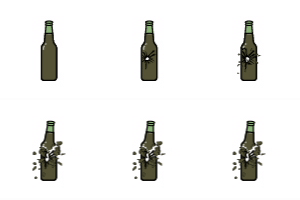
I Place the shards into the jar one by one. If I am recreating a beer bottle, I sort the shards like a puzzle. If I recreating a featureless glass vase, my piece placement can be much more abstract and "inaccurate." I sometimes will wrap a bottle with scotch tape before breaking. I then place the glass in a plastic bin (the shoebox size sterilite bins) where the scotch tape adhesive will lose hold of the glass and I'm left with properly sorted glass shards. Depending on the quality of the tape I may need to remove adhesive residue. Plastic razors or Q-tips work very well for this cleaning process.

When I've finished adding all of the glass, I fill the container with as much polymer as I can fit and top it off with water. Many different cylindrical objects can be used to assist here and my videos show this process in detail. When capping off the jar, I try to pack in as much polymer as possible. This does compress the glass within the jar slightly, moving or even changing the orientation of the glass within. This step is absolutely necessary however as I do not want the polymer to have any water filled gaps. I know if I have gaps when I rotate your jar and everything shifts. I should always be able to manipulate the jar and even shake it violently without anything moving within.

Painted beer bottles look best without backlight. I find they look great on windows and book shelves. Single color glass projects look great when backlit. Videos of completed projects and demonstrations are available here on YouTube

YouTube Shorts
I open a jar in this short
Inertial Mass demonstration with my cat Luci
Inertial Mass demonstration
Mexican Coca Cola 12oz
Mashup: Three purple vases
Mashup: Blue & yellow vases
Purple vase
Blue vase
Miller Lite 7oz #3
Alaskan Amber Ale 12oz
Jagermeister 700ml
Like Soda one pint
7up 70s one pint #2
Bud Light Platnium
Bubble Up 26oz
Heineken 12oz
Root 1 Cabernet 750ml
Jarritos Grapefruit Soda 12oz
Red Stripe 11.2oz
Tsingtao 12oz
Miller Lite 7oz #2
Coors Banquet 12oz
BAWLS Classic 12oz
BAWLS Ginger 12oz #3
Grain Belt 12oz
BAWLS Ginger 12oz #2
7up 70s one pint #1
BAWLS Ginger 12oz #1
(32 oz mason jar) Coors 7oz No label #2
(32 oz mason jar) Coors 7oz No label #1
(32 oz mason jar) Red Stripe painted 11.2oz #3
(32 oz mason jar) Red Stripe painted 11.2oz #2
(32 oz mason jar) Red Stripe painted 11.2oz #1
(32 oz mason jar) BAWLS Classic 12oz


YouTube Videos
These contain more details on the building process, including timelapses

Broken bottles frozen in time
This isn't resin, its better

STEM KIT INFORMATION
Available for free to Isanti County residents of any age. Contains 32oz jar, hydrated polymer, hemostat. No broken glass provided. Contact adam.j.guderian@gmail.com for information. Pickup in person only.

We are currently not shipping STEM kits. All items within the kit are generally available locally to any US resident. Contact for support sourcing materials.

COMMISSION
Not currently accepting work
Bottle Breaking

CC BY 4.0 LICENSING INFORMATION
(c) 2026 Adam Guderian. This work is licensed under the Creative Commons Attribution 4.0 International License (CC BY 4.0): https://creativecommons.org/licenses/by/4.0
You are free to share and adapt this work with appropriate credit.

Attribution: Adam Guderian, Guderianglass.com / Lordyboy.com
No one on this website told you to break glass.
No additional restrictions apply.